
How CRM and CMS are Shaping the Future of Aged Care
The way aged care providers attract, onboard, and retain clients has changed dramatically. Waiting lists are longer, expectations from families are higher, and competition is no longer about who has space. It is about who delivers the smoother, clearer, and more reassuring client experience from the very first interaction. Digital maturity is now the real advantage. Providers operating with a digital first mindset understand that care begins long before someone receives their first service. It starts the moment a family searches online for help. The providers who are excelling now are those using modern CRM and CMS systems that connect every part of the client journey and remove the friction that slows families down.
Australia’s aged care sector is facing extraordinary demand. By 2050, an estimated 3.5 million Australians will require aged care support. People want to age at home, and reforms are adding pressure to modernise. At the same time, the system is struggling to keep up. More than 121000 older Australians are waiting to be assessed for support at home. A further 87000 have been approved but are still waiting to receive their package. The total backlog now sits above 200000 people. Families are searching for answers, often urgently, and providers must do far more than simply appear on a waiting list. They must stand out through trust, clarity, and a seamless digital experience.
The challenge is that many providers are stuck with outdated intake processes. Recent industry data shows that 70 percent of providers rely on spreadsheets for intake. Around 45 percent rely only on the My Aged Care portal and 30 percent use basic CMS intake lists as their entire nurturing strategy. Families feel this immediately. Around 65 percent say the onboarding process feels confusing. Around 55 percent feel communication is scattered across emails and calls. Around 60 percent struggle to understand pricing and services. Around 40 percent experience delays that impact trust. These pain points are exactly where CRM and CMS tools transform the experience.
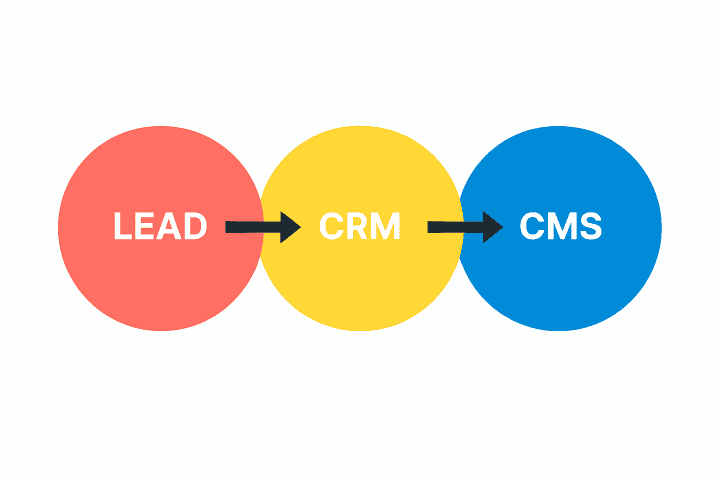
Although CRM and CMS are often discussed together, they serve completely different purposes. A CRM manages everything before a person becomes a client. It is the growth engine of the organisation. It captures website enquiries, campaign leads, and referrals, automates follow up, supports digital marketing, manages government and stakeholder relationships, and guides families through a calm, structured, and transparent onboarding journey. It gives providers full visibility of every lead and every step in the journey.
A CMS is the operational backbone. It manages everything that happens once a person becomes a client. It handles client records, care plans, service schedules, rostering, documentation, compliance, and communication across care teams. It keeps operations flowing and ensures services are delivered consistently and safely.
Many providers ask whether they can simply use their CMS to handle intake. After reviewing the top systems across the sector, the answer is clear. While CMS platforms offer basic intake capture, they do not replace proper CRM functionality. They lack true lead nurturing journeys, marketing integration, timed follow ups, stakeholder tools, and simple digital onboarding without additional workarounds. This is why the most successful digital first organisations rely on both systems. One attracts and nurtures, the other delivers and maintains.
Digital first providers are lifting their performance by embracing this combined approach. They create faster onboarding, more confident communication, stronger visibility, clearer pricing discussions, and better long term retention. A powerful example is a provider that used modern CRM tools to automate its full onboarding experience. Their onboarding time dropped from 9 days to 2. Staff saved more than 12 hours each week. And, most importantly, families described the process as simple, modern, and easy to understand.
The real risk now lies in not adopting digital tools. Without a CRM, leads go cold, families feel overwhelmed, referrals slow, and opportunities are lost to providers who follow up consistently. Without a CMS, care delivery becomes inconsistent, compliance becomes risky, and teams become stretched. Together, CRM plus CMS create a connected ecosystem that supports every stage of the client lifecycle.
The next decade will be defined by providers who invest early in digital capability. A modern CRM strengthens attraction, onboarding, and retention. A well implemented CMS strengthens quality, efficiency, and daily operations. Together they deliver a client experience that feels modern, trustworthy, and effortless. Families choose providers who make their lives easier, and digital tools make that possible.
If you would like help reviewing your CRM and CMS ecosystem or want support designing a digital first client experience, you can book a time with me here:
You can edit text on your website by double clicking on a text box on your website. Alternatively, when you select a text box a settings menu will appear. your website by double clicking on a text box on your website. Alternatively, when you select a text box
WHAT IS THE DIFFERENCE?
CRM | CMS |
Focuses on attracting and nurturing potential clients | Focuses on managing clients after they start receiving services |
Manages enquiries, leads, and pre admission information | Manages care plans, service delivery, and ongoing support |
Supports marketing campaigns, email, SMS, website forms, and digital engagement | Supports rostering, scheduling, and operational workflows |
Tracks all interactions with families, referrers, and prospects | Tracks care notes, assessments, documentation, and compliance |
Automates follow ups, reminders, and nurturing sequences | Automates tasks like scheduling, billing, reporting, and worker coordination |
Helps increase conversion rates from enquiry to service | Ensures high quality service delivery and regulatory compliance |
Provides visibility of the sales pipeline and intake performance | Provides visibility of client status, risks, incidents, and service progress |
Integrates with marketing tools and communication channels | Integrates with finance, payroll, and workforce systems |
Latest News Posts
Loading latest blog post...
Loading additional blog posts...